1. Planning Long-Term Financial Safety for Your Family
Imagine welcoming a newborn daughter into your family or setting aside funds for your long-term retirement. You want total financial safety—meaning zero risk of stock market drops—combined with maximum tax savings.
When you visit a post office or bank branch, officials suggest Sukanya Samriddhi Yojana (SSY) or Public Provident Fund (PPF). While both schemes offer sovereign safety, key eligibility and interest rate differentials set them apart.
2. What Is EEE Tax Status?
Both SSY and PPF belong to the rare **Exempt-Exempt-Exempt (EEE)** tax category:
- Exempt 1 (Investment): Deposits qualify for tax deduction under Section 80C up to ₹1.5 Lakh annually.
- Exempt 2 (Accumulation): Annual interest earned compounds 100% tax-free.
- Exempt 3 (Maturity Payout): Total final lump-sum payout upon maturity is completely tax-free.
Sukanya Samriddhi Yojana vs. Public Provident Fund
Higher quarterly interest rate benchmarked for girl child education & marriage.
Open to all Indian adult citizens with a 15-year tenure and partial loan options.
100% tax-free investment, annual interest compounding, and final maturity payout.
3. The Compounding Advantage of SSY for Girl Children
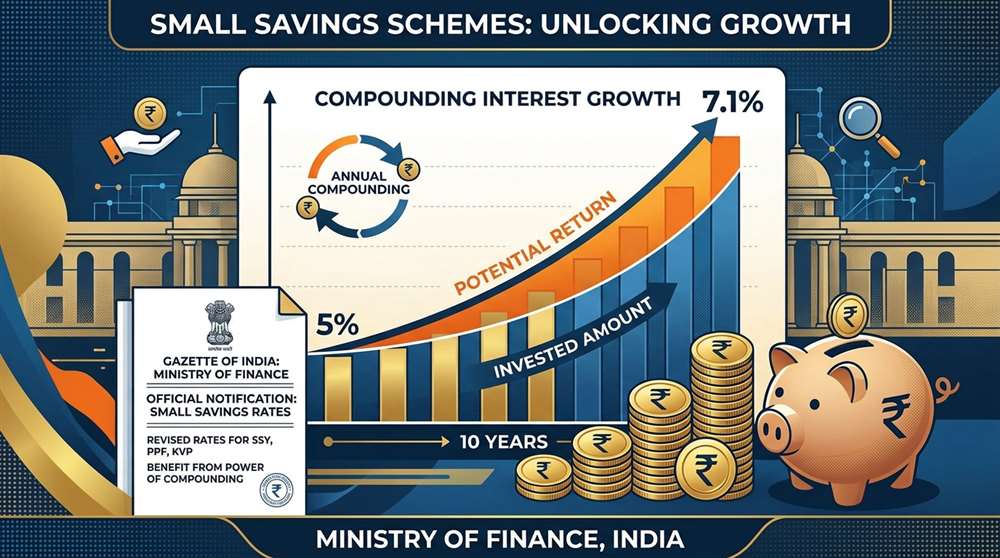
Because Sukanya Samriddhi Yojana carries an elevated interest rate differential compared to standard PPF, compounding over a 21-year maturity horizon creates a substantial financial corpus for higher education or marriage expenses.
4. Practical Tips to Maximize Returns
- Deposit annual contributions before the **5th of the month** to earn interest for that full calendar month.
- Utilize online post office / net-banking auto-debits to ensure zero deposit default penalties.
- Claim up to ₹1.5 Lakh annual tax deduction under Section 80C.
5. The Big Picture Verdict
For families with eligible girl children below age 10, Sukanya Samriddhi offers superior compounding growth. For general adult retirement planning, PPF remains an unbeatable sovereign tax-free cornerstone.
NOTICE ON ACCURACY: While every reasonable effort is made to maintain factual precision, statutory rules, government notifications, and public datasets are subject to official revision over time. Content may contain unintentional errors or omissions, and readers are advised to cross-verify all regulatory information directly with primary government portals.